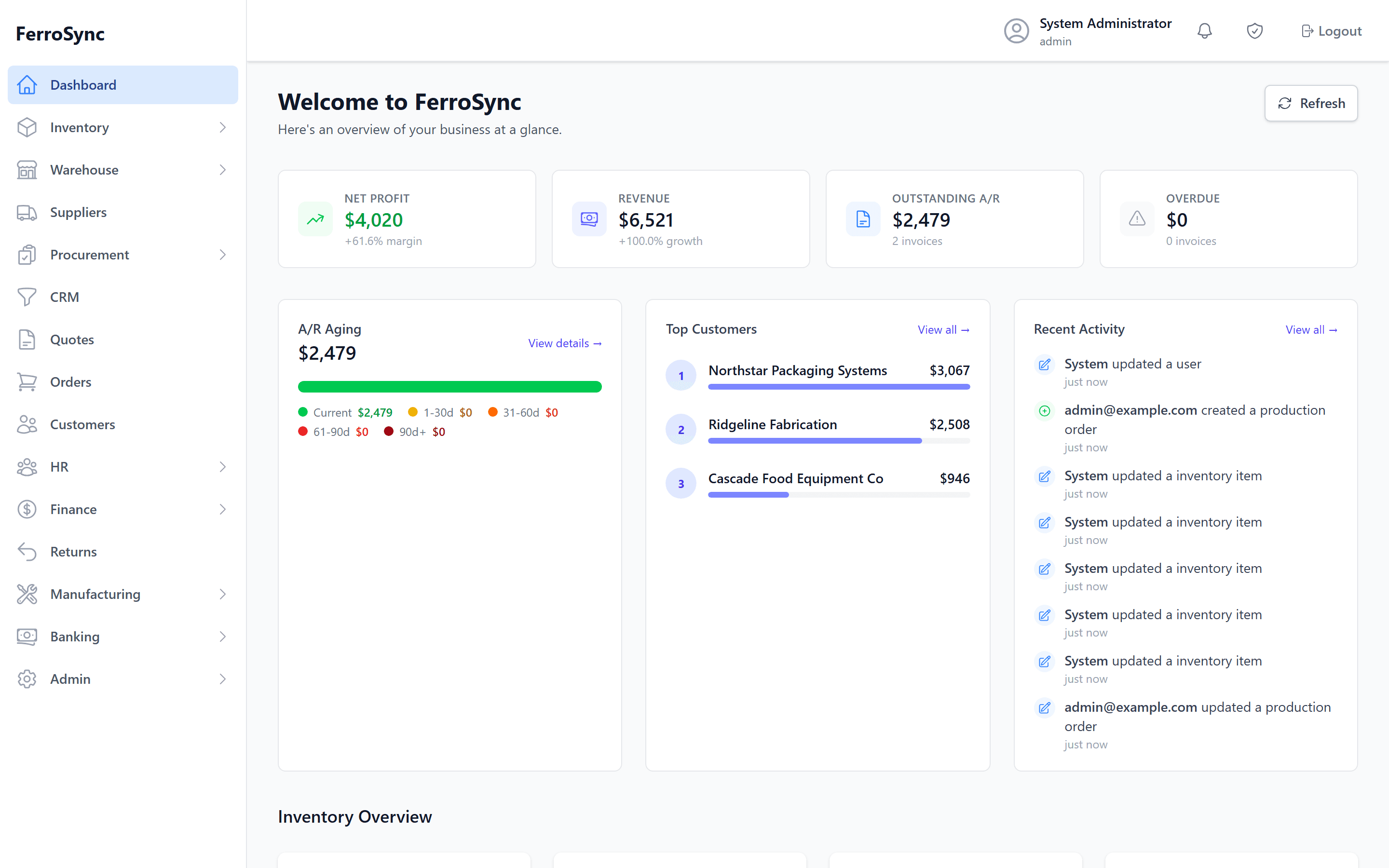
Four Modules, One System

What FerroSync does — and how it works

Inventory, orders, customers, and finance share the same PostgreSQL database and authentication layer. Changes in one module are immediately visible in the others.

Inventory Management

Know what you have. Know where it is.

Track items across warehouses with stock movement history, category organization, and supplier management. Every movement is audited with timestamps and user attribution.

Real-Time Stock Levels
Current quantities update as items move in and out. No batch sync — changes are immediate.
Low Stock Alerts
Set thresholds per item. The system flags items approaching reorder points automatically.
Multi-Warehouse
Manage inventory across locations from one interface. Transfer stock between warehouses with full tracking.
Stock Movement Audit Trail
Every addition, removal, and transfer is logged with timestamp, user, and reason. Full traceability.
Category & Supplier Management
Organize items by custom categories. Link items to suppliers with contact and pricing details.
Barcode Scanning
Look up items and record movements by scanning barcodes. Reduces manual entry errors.
Order Processing

From order placed to order shipped.

Orders move through a defined lifecycle — pending, processing, shipped, delivered. Inventory is reserved on creation and released on cancellation. No manual reconciliation.

Status Lifecycle
Orders progress through defined states. Each transition is tracked with timestamps.
Inventory Reservation
Creating an order reserves stock automatically. Cancelling releases it back. No manual adjustments.
Bulk Operations
Process, update, or ship multiple orders at once instead of one at a time.
Customer Linking
Every order is tied to a customer record. View a customer's full order history in one place.
Cancellation Handling
Cancel orders cleanly. Reserved inventory returns to available stock. The audit trail records why.
Shipment Tracking
Record shipment details against orders. API structure supports shipping provider integrations.
Customer Management

Every customer, one place.

Store contact details, billing and shipping addresses, and order history per customer. Search across name, email, or company. Track active vs. inactive status.

Full Customer Profiles
Contact details, company info, and notes in one structured record.
Multiple Addresses
Separate billing and shipping addresses per customer. Orders reference the right address automatically.
Order History
See every order a customer has placed, with status, dates, and totals.
Search & Filtering
Find customers by name, email, company, or status. Results are instant via indexed queries.
Revenue Attribution
See each customer's total revenue contribution. Identify your highest-value relationships.
Activity Tracking
Flag active and inactive customers. Focus attention where it matters.
Financial Dashboard

Revenue in. Invoices out. Nothing hidden.

Generate invoices from orders, record payments (including partial), and track what's outstanding. Revenue reports slice by customer, time period, and category.

Invoice Generation
Create invoices from orders with line items, totals, and tax calculations. Export to PDF.
Payment Recording
Record full or partial payments against invoices. Track payment method and date.
Revenue Reports
Analyze revenue by customer, time period, or product category. Filter by date range.
Accounts Receivable
See unpaid and overdue invoices at a glance. Aging reports show how long invoices have been outstanding.
Top Customer Analytics
Rank customers by revenue contribution. Spot trends in purchasing behavior.
Chart of Accounts
Structured account categories for organizing transactions. Maps to standard accounting workflows.

Under the Hood

FerroSync is built on a stack chosen for reliability and performance, not hype.

Auth & Access Control
JWT access tokens with refresh token rotation. Role-based access control with granular permissions per module. Admin and user roles out of the box.
Rust Backend
Compiled, async, memory-safe. The backend is written in Rust with type-checked queries against PostgreSQL. No ORM magic — you can read the SQL.
API-First Design
Every feature is accessible through a REST API. The React frontend is one client — you can build your own, or integrate with existing systems.

Try it. The demo is live.

Explore all four modules with sample data. No setup, no credit card.

Join Waitlist